It starts with a floor that is not flat
Most relevelling enquiries on the border begin the same way. A door in the hallway that latched last autumn now catches at the top. A marble put down in the lounge rolls to the same wall every time. A gap has opened between the skirting and the floorboards in the back bedroom, and a diagonal crack has run from the corner of a door frame toward the cornice. None of those says what has happened under the house. They say the floor has dropped on one side, and the floor only drops when what is carrying it has moved. The signs guide goes through each symptom in turn; this page is about what to do when the inspection finds the stumps themselves are still sound.
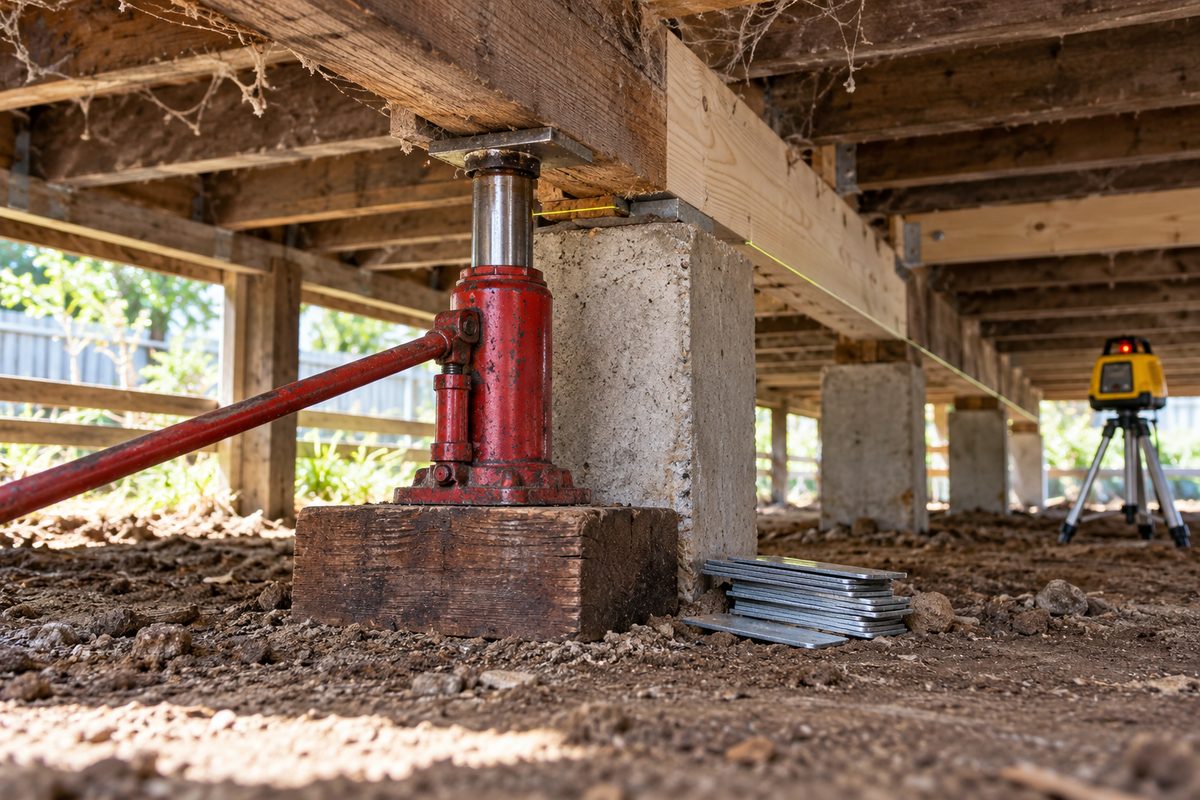
Relevelling lifts the house a few millimetres at a time on jacks placed under the bearers near the low stumps, brings the floor back to one laser line, and fills the gap between the top of each stump and the bearer with galvanised steel packers. On adjustable steel stumps the head is wound up instead. The trade calls it jack and pack. No stump comes out, no hole is dug, and the house is back where it was built in a day or two. It suits a house whose stumps have sunk into softened clay, or were packed badly last time, but are plumb, solid and dry at the ground line. It does not suit a house whose stumps have rotted or been eaten, because a soft stump cannot be packed; it has to be replaced, and that is restumping on the Albury side or reblocking on the Wodonga side.
Why a sound stump still sinks here
The ground on both sides of the river is reactive clay, and the climate works it hard. The Bureau of Meteorology's Albury Airport record gives a mean annual rainfall of 639.2 mm, a mean January maximum of 32.5 degrees and a mean July minimum of 3.1 degrees: hot dry summers, cold wet winters. The clay shrinks and cracks open in late summer, then swells and closes after the winter rain. A stump founded in the top of that layer rides it, dropping a little when the clay is dry and rising when it is wet, and over twenty or thirty seasons the packing between stump and bearer, if there was any, crushes or walks out. The timber is fine, the concrete is fine, the stump is just lower than it was, or the bearer is sitting on air above it.
How much the ground moves is a matter for a soil test. The two soil reports we have seen for Wodonga-side estates, one at Riverside Estate in Killara and one at Silky Oaks, classify the sites as Class M-D and Class M under AS 2870, with expected surface movement of 20 to 40 mm on the first; they are two lots, not the whole town, and no report for the Albury side was found. What they show is that a footing set shallow in border clay can be expected to move with the season. Water makes it worse in one spot: a downpipe discharging at the corner, a garden bed built up against the baseboards, paving that falls toward the house. The stumps under that corner go lower than the rest, and the floor tells you which corner it is.
| What the inspection finds | What it means |
|---|---|
| Stumps plumb and solid, bearers sound, floor out of level | Relevel. Jack and pack, usually a day or two, no digging, no new footings. |
| Stumps sound, a bearer soft at one end | Relevel plus a bearer repair. The floor comes up where the bearer is replaced; see the subfloor repairs page. |
| A few stumps rotted, leaning or eaten, most sound | Replace the failed ones and relevel the rest. One job, one set of paperwork. |
| Most stumps soft at the ground line or standing in water | Full restump or reblock. Packing on rotten stumps buys a winter, no more. |
| Concrete stumps sunk unevenly on one side, ground wet | Relevel, then fix the drainage. If the ground keeps moving, adjustable steel on the worst corner. |
| Thick stacks of brick, tile or timber packing under the bearers | The house has been relevelled before, cheaply. Probe the stumps under the packing before lifting against it. |
| Brick veneer on a slab or strip footing, cracking | Not a relevel at all. Footing movement is an engineer and underpinning. |
How a relevel runs
- Levels. A laser or water level is run through the house and under it. The high point is found, the low points are measured against it, and the pattern is read: one corner down is one or two stumps, a whole side down is drainage or the ground, a dip in the middle of a room is a bearer or a joist.
- Every stump probed. Soft, hollow, leaning or wet stumps are listed by position and taken off the relevel list, because a jack cannot lift against a stump that is giving way. If the list is long, the job has changed and the owner hears that before a crew is booked.
- Old packing found. Many older border houses have been relevelled two or three times with whatever was to hand. A loose stack of bricks under a bearer is cleared before anyone lifts against it.
- Jacking. Bottle jacks on hardwood pads go under the bearers beside the low stumps. The house comes up in small lifts, checked against the laser each time, so plaster, cornices and any brickwork are not shocked. On a brick veneer with a timber floor the lift is kept very small.
- Packing. Galvanised steel packers, bedded flat. Timber wedges are not used; they crush and the floor drops again. On adjustable steel stumps the head is wound up to the line.
- Doors and cracks. As the floor comes level, doors that were planed to fit a sagging frame can bind and some cracks shift. Some close; the ones that do not are patched afterwards.
- Drainage. If the stumps sank because the ground stays wet, the ground under the house is regraded and vents are added, otherwise the relevel is temporary.
Paperwork: it depends which side of the river, and what comes out
On the Albury side, relevelling is residential building work under the Home Building Act 1989 like any other repair. Over $5,000 including GST the contractor needs a NSW licence and a written contract; over $20,000 the large job contract and Home Building Compensation cover apply. Approval is usually not an issue: the Codes SEPP lists "restumping or repairing structure foundations without increasing the height of the structure" as an exempt example, and a relevel that brings the floor back to the line it was built on, without lifting it higher, sits inside that wording in practice. The certifier or council decides, not the builder, and on a heritage item or inside one of Albury's heritage conservation areas the exempt route does not apply at all. Lifting the house higher than it was built is a different thing, and a planning matter.
On the Wodonga side the question is whether the work stays inside the repair and maintenance exemption in the Commission's practice note BP-01. That exemption applies only where the work will not adversely affect the structural soundness of the building and does not include "underpinning or replacement of footings" or the removal or alteration of any element contributing to the support of another. Packing a bearer on an existing stump may fall inside it; the registered building surveyor makes that call. The moment a stump comes out or a bearer is cut, the exemption ends, a building permit is needed, and the City of Wodonga's permit table lists reblocking or restumping of an existing building among the works that need one. Either way the builder should be registered: the regulator requires registration for restumping and reblocking regardless of value, relevelling is done by the same trade with the same jacks, and the Commission's register is where to check. The border page explains what changes when the crew crosses the river.
Timing on border clay
A relevel on reactive clay is a relevel against a moving target, and the season matters. A house packed level in August, when the clay is at its wettest and highest, can sit low again by March as the ground dries and drops. Where there is a choice, the levels are taken in late summer, when the Albury record says the ground is driest, and the relevel is done then, so the floor is set against the low point of the cycle rather than the high. Where there is no choice, because a sale or a builder is waiting, the crew sets the floor and the owner is told what the next summer may do. On the worst corner, an adjustable steel stump lets the floor be wound back up later with a spanner rather than another day under the house, and the choice is made with the builder on the inspection.
What a relevel quote should say
A relevel is a small job and the quote is often a line or two, which is where trouble starts. It should name the stumps to be packed by position and the lift expected at each. It should say the packer material, and that it is steel. It should list the stumps the inspection found soft, leaning or wet and are therefore not being relevelled on, and what happens to them. It should say whether the surveyor has been asked about a permit on the Wodonga side, or whether the exempt wording has been checked on the Albury side, and what the answer was. It should say how a bearer found soft while the jacks are under it will be priced. And it should say whether the ground under the house is being regraded and vents added, because on border clay a relevel without drainage is a relevel booked again in three winters. If the quote says relevel the house and nothing else, ask for the rest in writing before the crew arrives.
What relevelling cannot fix
Relevelling cannot make a rotten or termite-eaten stump sound; it can only sit a bearer on it for a while. It cannot stop reactive clay moving with the seasons, so on a wet corner it needs drainage or an adjustable stump behind it to last. It cannot square a door frame that was racked when the house dropped; a carpenter does that once the floor is level. It cannot fix a brick veneer on a strip footing or a slab home on one of the newer estates, which is underpinning on an engineer's design. And it cannot settle the permit question for you: on the Wodonga side the registered building surveyor decides whether a relevel stays inside the repair exemption, and on the Albury side the certifier or council decides whether the exempt wording applies to your house.
Check the current rules before you rely on this
This page describes house relevelling on existing stumps on both sides of the border and when it becomes a restump, a reblock or permitted building work. It describes the rules in general terms as they stood in October 2026. Standards, forms, thresholds and fines change.
The authoritative sources are Building and Plumbing Commission, practice note BP-01, when is a building permit required, Victorian Building Authority, clarification of registration requirements for domestic builders, Building and Plumbing Commission, find and check a practitioner, NSW Government, general building work licence, NSW Planning, remedial building work fact sheet and Bureau of Meteorology climate statistics, Albury Airport AWS. Where anything here differs from those sources, they are right and we are not.
We are not certifiers, building surveyors, engineers, planners or lawyers. For what applies to your house, ask a licensed builder, a certifier or building surveyor, or your council (City of Wodonga on 02 6022 9300 or Albury City Council).
Accurate at the time of writing, October 2026. Always check the source before relying on it.