The short version
On the Wodonga side of the river, reblocking, restumping, relevelling with new footings and underpinning are all building work under the Building Act 1993, and every one of them needs a building permit from a registered building surveyor before anything is dug. The builder must be registered with the Building and Plumbing Commission whatever the job costs, because restumping is one of the trades where the usual $10,000 threshold does not apply. Over $10,000 the job needs a written major domestic building contract, and from 1 July 2026 the builder must take out Home Warranty insurance once the work costs more than $20,000. City of Wodonga does not issue the building permit but its own table says reblocking needs one, and most works also need its Road Reserve Works Permit. This is the Victorian page; for a house in Albury the rules sit on the New South Wales page.
Why reblocking needs a building permit
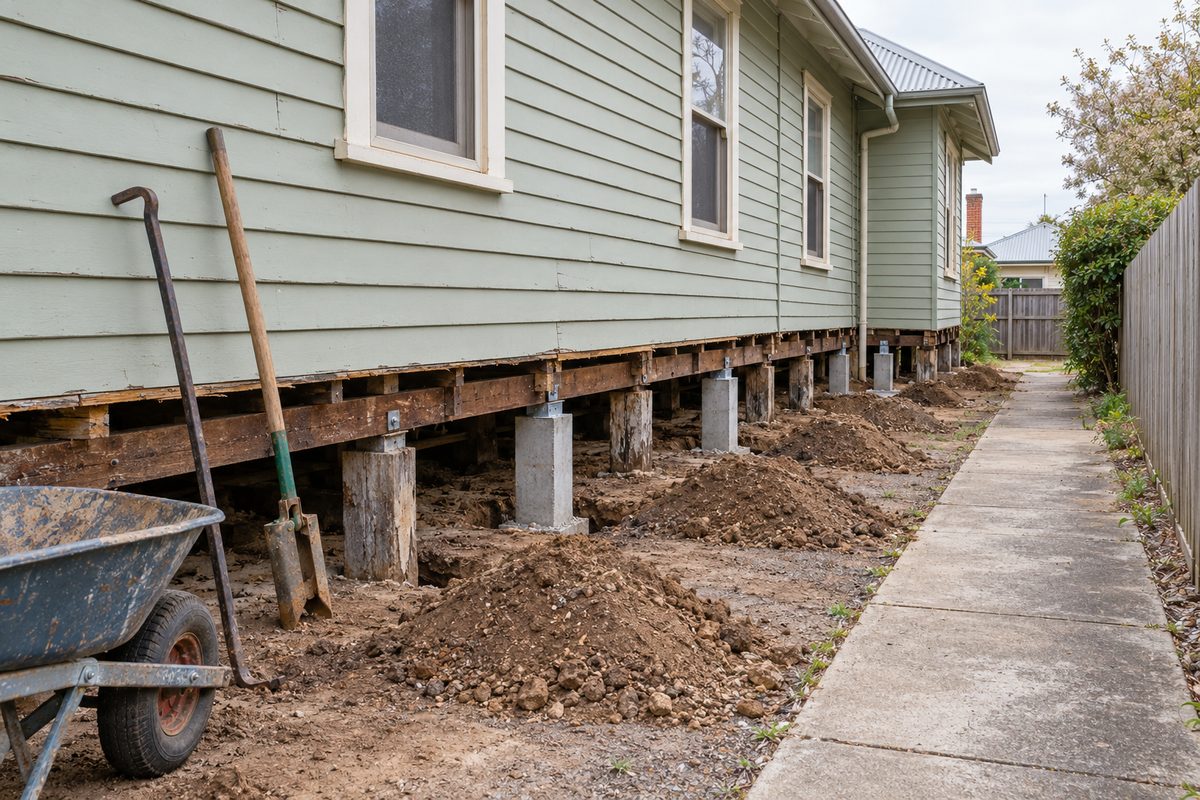
The Building and Plumbing Commission's practice note BP-01, when is a building permit required, version 5.1 of 20 December 2023, starts from the position that any building work needs a permit unless an exemption in Schedule 3 of the Building Regulations 2018 applies. The exemption for repair, renewal or maintenance of part of an existing building only applies if the work will not adversely affect the structural soundness of the building, and it expressly does not include an increase or decrease in the floor area or height of the building, underpinning or replacement of footings, or the removal or alteration of any element of the building that is contributing to the support of any other element. Stumps are footings and they support everything above them. The separate exemption for alterations, item 4 in the schedule, carries the same exclusion for underpinning or replacement of footings and does not apply to a building on the Victorian Heritage Register. So replacing stumps, underpinning a strip footing or swapping out a bearer sits outside both exemptions and needs a permit. Relevelling a house on sound existing stumps with nothing replaced is the one job on this site that may sit inside the repair exemption, and the surveyor decides that, not the reblocker.
This site has not read the Building Regulations 2018 text itself and relies on the Commission's practice note, which is the regulator's own summary of it. The regulations are indexed on the Victorian legislation site for anyone who wants the primary wording.
What City of Wodonga says
The council's page on whether you need a building permit has a table of works, and "Reblocking or restumping of an existing building" is on it, alongside "Structural alterations, and removing or altering a load-bearing part". The same page says most works also need a Road Reserve Works Permit, which covers anything the job does in the road reserve, such as a skip, a truck parked for the spoil or a crossover used by a small machine. Owner-builders doing work over $16,000 need a Certificate of Consent. The council's building office is at 104 Hovell Street, Wodonga, on 02 6022 9300, and its building landing page is the place to start for the Road Reserve Works Permit and any council consents the surveyor asks for.
Wodonga is not unusual in this. Hume City Council says restumping or completing underpinning work requires a building permit, and Macedon Ranges Shire's restumping guideline asks for a registered builder, drawings showing the stump type, size and sole plate, and an engineer's computations where required. Those are other councils' pages, quoted here only to show that the rule is state-wide; the local rule for a Wodonga house is the City of Wodonga table and the Commission's practice note.
Who issues the permit
A private registered building surveyor. The council does not issue it. In practice the reblocker nominates a surveyor they work with, the surveyor checks the planning overlays on the lot, asks for drawings of the stump layout and an engineer's design where the job is underpinning or the ground calls for it, issues the permit, inspects at the stages the permit sets, and signs off at the end. The surveyor sets their own fee and the quote should say whether it is inside the price; ask the surveyor for the current figure. The permit comes before the first hole.
Who can do the work
A builder registered with the Building and Plumbing Commission. Victoria's general threshold for domestic builder registration has been $10,000 since 1 August 2017, but the regulator, then the Victorian Building Authority, clarified in 2017 that re-blocking or restumping a home requires registration regardless of the value of the work, and the companion notice on work under $10,000 says the same. Consumer Affairs Victoria's page on preparing a major domestic building contract repeats it: a builder must be registered to restump or reblock a home regardless of the value. There is a registration class limited to re-stumping and re-blocking, so a reblocker does not have to hold an unlimited domestic builder registration, but they do have to hold one.
The Commission replaced the Victorian Building Authority on 1 July 2025, taking over domestic building insurance and dispute resolution at the same time, which is why older paperwork says VBA and DBI where current paperwork says BPC and Home Warranty. Ask for the registration number with the quote and check it on the Commission's practitioner register. Interstate builders working here under mutual recognition must notify the Commission before starting; the border page covers that.
Contracts and insurance
| Threshold | What applies | Source |
|---|---|---|
| Any value | The builder must be registered with the Building and Plumbing Commission to restump or reblock a home. The $10,000 general threshold does not apply. | Commission clarification, Consumer Affairs Victoria |
| Over $10,000 | A written major domestic building contract under the Domestic Building Contracts Act 1995. | Consumer Affairs Victoria |
| Over $16,000 | Owner-builders need a Certificate of Consent. Before 1 July 2026 this was also the domestic building insurance threshold. | City of Wodonga, Consumer Affairs Victoria |
| Over $20,000 | From 1 July 2026 the builder must take out Home Warranty insurance for eligible work, up to three storeys. The builder pays the premium; the Commission sends the owner a notice of cover after the contract is signed. | Commission, Consumer Affairs Victoria |
Consumer Affairs Victoria's domestic building consumer guide explains the change: before 1 July 2026 domestic building insurance applied over $16,000, and from that date Home Warranty insurance applies where the work costs more than $20,000, with the Commission sending a notice of cover after the contract is signed. The Commission's insurance page says eligible work over $20,000 must be covered and the registered builder is responsible for the premium. The Domestic Building Contracts Act itself is indexed on the Victorian legislation site; this site relies on Consumer Affairs Victoria's summary of it.
A reblock quoted just under $20,000 that grows once the bearers are opened up has crossed the insurance line, and the contract should say how that is handled; splitting one house into two contracts to stay under it is the same job with the cover removed. A quote that promises Home Warranty cover should be followed by the notice of cover itself before the crew arrives.
Termites, clay and flood on the Wodonga side
Three local things the surveyor will ask about. The National Construction Code's Housing Provisions Part 3.4 require termite risk management where subterranean termites present a potential risk, and point to AS 3660.1. City of Wodonga was historically listed as a termite-declared area; this site has not confirmed the current position from a government page, so confirm with your building surveyor what the permit requires. In practice new stumps are concrete or steel with ant caps on top, and termite-eaten timber stumps are a standard reason for reblocking in the region.
The ground is reactive clay. Soil reports we have seen for two Wodonga-side estates classify the sites as Class M under AS 2870. The Killara report for a lot in Riverside Estate came back M-D, moderately reactive and deep, in silty and sandy clays, with surface movement of 20 to 40 mm and stumps and piers to go at least 600 mm below the surface. The Silky Oaks Estate report in Wodonga came back Class M in sandy clays of medium to high plasticity, with stumps and piers at least 500 mm down and an allowable bearing pressure of 100 kPa from 300 mm. The class of your site is set by a geotechnical test, and the surveyor may ask for one or for an engineer's design before issuing the permit. The clay guide goes through what the reports say.
Flood is a planning overlay question rather than a building permit one. Victoria SES's Wodonga flood guide puts the city about 20 km downstream of Hume Dam, with most of the urban area outside the Murray floodplain but Gateway Island inside it, and local flooding from Felltimber Creek, House Creek including Huon Creek, and Jack in the Box Creek, as in October 2016. The North East Catchment Management Authority explains that land in the 1 per cent flood appears in the planning scheme as a Land Subject to Inundation Overlay or a Floodway Overlay, and a planning permit is typically needed for works there. Reblocking at the same floor height is unlikely to trigger those overlays; raising a house on the floodplain is a planning matter. Check the overlay for the address, and the surveyor will do the same before issuing the permit.
What happens in what order
- Inspection and quote. The reblocker goes under the house and produces a stump count, a view on the bearers and a written price. The cost guide says what it should name.
- Registration check. The number on the quote is checked on the Commission's register, at any job value.
- Contract. Over $10,000, a written major domestic building contract with the registration number on it.
- Surveyor. The builder or the owner engages a registered building surveyor, who checks the overlays and asks for drawings and any engineer's design.
- Home Warranty, if over $20,000. The builder takes it out after signing and the Commission's notice of cover arrives before work starts.
- Council permits. The Road Reserve Works Permit from City of Wodonga if the job touches the road reserve, and any consent the surveyor asks for.
- Permit, work, inspections, sign-off. The surveyor inspects at the stages the permit sets and closes it at the end. Keep the paperwork with the house; the next buyer's conveyancer will ask for it.
What a building permit cannot do
A building permit cannot make a reblocker competent; the Commission's registration and the surveyor's inspections do that. It cannot be obtained from City of Wodonga, however many times you ring Hovell Street; the council's role is the Road Reserve Works Permit and the consents the surveyor asks for. It cannot cover work that started before it was issued. It does not replace the contract, which over $10,000 is a separate legal requirement, or the Home Warranty cover, which over $20,000 is the builder's to take out. And it cannot tell you whether the lot is under a flood overlay or what class the clay is; the planning scheme and a geotechnical test do that.
Check the current rules before you rely on this
This page describes the building permit, registration, contract and insurance requirements for reblocking and restumping on the Victorian side of the border for Wodonga home owners. It describes the rules in general terms as they stood in October 2026. Standards, forms, thresholds and fines change.
The authoritative sources are Building and Plumbing Commission, practice note BP-01, when is a building permit required, City of Wodonga, do I need a building permit, Victorian Building Authority, clarification of registration requirements for domestic builders, Consumer Affairs Victoria, preparing a major domestic building contract, Building and Plumbing Commission, domestic building insurance and Building and Plumbing Commission, find and check a practitioner. Where anything here differs from those sources, they are right and we are not.
We are not certifiers, building surveyors, engineers, planners or lawyers. For what applies to your house, ask a licensed builder, a certifier or building surveyor, or your council (City of Wodonga on 02 6022 9300 or Albury City Council).
Accurate at the time of writing, October 2026. Always check the source before relying on it.