What is under the floor, and what goes wrong with it
A timber floor on stumps has three layers of structure. Stumps carry the load into the ground. Bearers are the heavy timbers that run along the tops of the stumps. Joists run across the bearers, closer together, and the floorboards or sheet flooring are fixed to them. In a border house built before the 1970s the lot is usually hardwood, and all of it has spent decades a few hundred millimetres above reactive clay that is dry for months and wet for months. Bearers rot where they sit on a stump that has held water, where a leaking shower or a disconnected downpipe has kept one corner damp, and where the end of a bearer is let into a brick pier or buried under a verandah. Joists rot under bathrooms and laundries and at their ends on an outside bearer. Termites take whatever is left: a termite-eaten stump is one of the standard reasons a border house is restumped at all, and the galleries that start in a stump run up into the bearer above it.
This page covers the work on those three layers when it is less than a full restump: one or a handful of stumps replaced, a length of bearer cut out and spliced, joists sistered or replaced, and termite-damaged timber removed and made good. The restumping Albury and reblocking Wodonga pages cover the whole-house job; the relevelling page covers packing a floor level on stumps that are still sound.
When it is found
Almost always during restumping or relevelling. The baseboards are off, the house is on jacks, the crew is under the floor with a torch, and the bearer that looked sound from the side is soft when it is probed. That is the cheapest moment to replace it and the worst moment to argue about price, which is why a restumping quote should say in advance how bearer and joist work is charged: per metre of bearer, per joist, and whether lifting the floor is included. It is also found by building inspectors before a sale, by pest inspectors following galleries up from the stumps, and by renovators lifting a bathroom floor in a South Albury cottage or a 1970s Lavington house to find there is less holding it up than there was.
The symptoms inside point to the layer. A floor that slopes toward one wall is usually a stump. A dip or a bounce between two firm points is usually a bearer or a joist, because the stumps either side are doing their job and the timber between them is not. A soft spot by the shower or the laundry trough is joists and flooring rotted from above, with the bearer below starting. Mud tubes on a stump and frass on the ground are termites in the timber above.
| What you notice | What it usually is | What is done |
|---|---|---|
| Floor dips between two stumps, both stumps sound | Bearer sagged or rotted at a stump | Bearer cut back to sound timber over a stump and a new hardwood length spliced and bolted in. |
| Floor bounces in one room, stumps fine | Joists undersized, cut for old plumbing, or rotted at the ends | Joists sistered alongside the old or replaced in galvanised hangers. |
| Soft spot by the shower or laundry trough | Joists and sheet flooring rotted from above, bearer below starting | Floor up, joists out, bearer checked, the leak fixed by a plumber first. |
| One corner low, the rest of the floor level | A single stump rotted at the ground line or sunk into wet clay | That stump replaced in concrete or steel with an ant cap, the bearer repacked. |
| Mud tubes on a stump, frass on the ground, timber that sounds hollow | Termites in the stump and the bearer above | Damaged timber out, pest controller in, ant caps on, an inspection schedule afterwards. |
| Verandah floor low at the front step | Short verandah bearer on short stumps close to wet ground | Bearer replaced, stumps checked, ground graded away from the house. |
| Tide mark along the bearers at one height on one side | That side of the house stands in water each winter | Drainage and vents first, then the timber, or the new timber goes the way of the old. |
How the repair runs
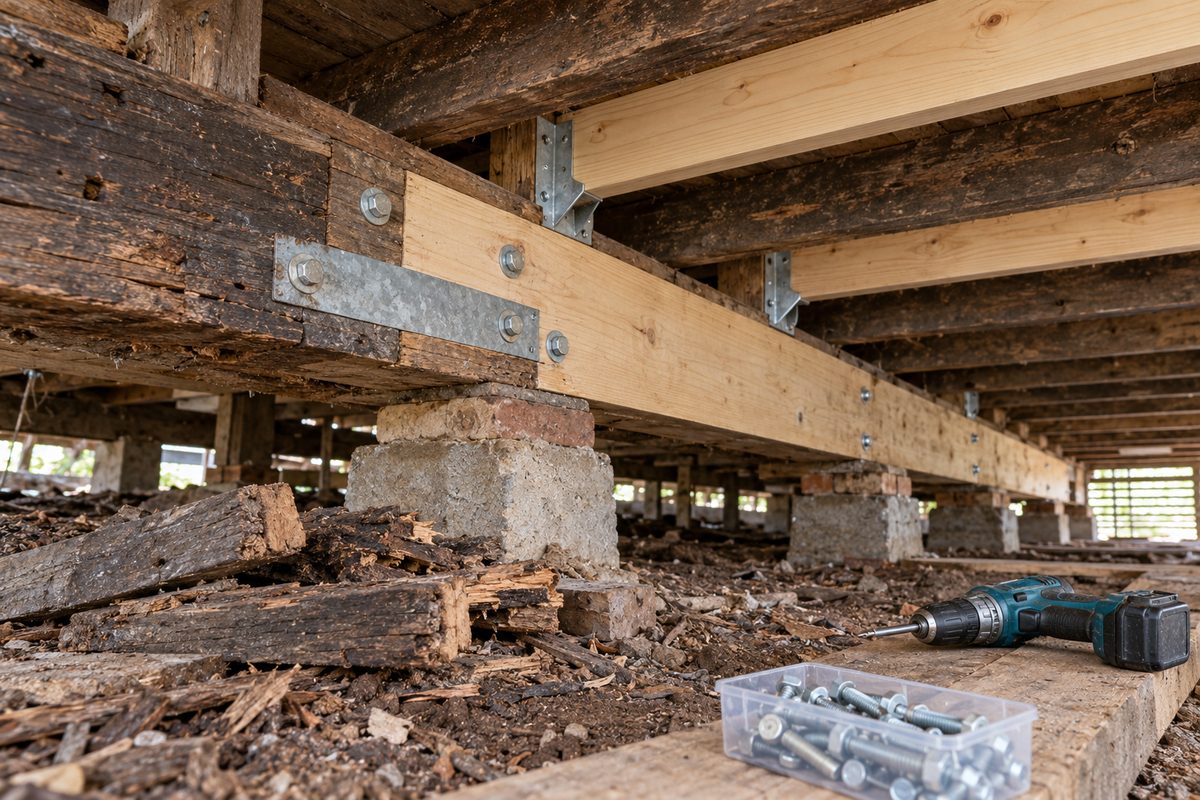
- Find the extent. Rot is probed along the bearer until sound timber is reached. Half a metre of soft timber at a stump often means a metre and a half comes out. Termite galleries are traced the same way, and the pest controller is called before anything is cut.
- Support the floor. Jacks and props carry the joists either side of the section being replaced, so the floor above does not drop while the bearer is out.
- Stumps. Where a stump under the rot has gone too, it comes out first: jacks take the load, the old stump is cut out and dug up, the new hole goes to firm clay, and a concrete or galvanised steel stump goes in plumb with an ant cap. The cost guide explains why one stump still carries most of the set-up of ten.
- Bearers. The rotten length is cut back to sound timber over a stump, and a new hardwood bearer of the same section is scarfed and bolted to the old with galvanised bolts and a strap, sitting on the ant cap below.
- Joists. Rotted joists are cut out and new hardwood joists fitted in galvanised hangers, or sistered alongside the old where the old is sound enough to help. Under wet areas the floor comes up to do it, and the plumber fixes the leak before the new timber goes in.
- Treat and ventilate. Where termites were the cause, a licensed pest controller treats the house and sets up an inspection schedule. Where damp was the cause, vents are added and the ground regraded; otherwise the new timber is on the same clock as the old.
- Relevel and close up. The repaired bearers are packed back to the laser line, the baseboards go on, and the paperwork is closed off on whichever side of the river the house stands.
Termites: the NCC test, and what each side of the river says
The NCC 2022 Housing Provisions, Part 3.4 deals with termite risk management for a Class 1 or Class 10 building in an area where subterranean termites present a potential risk, and references AS 3660.1 for the management systems. That is written for new work rather than for a repair, but the logic carries across: a replaced stump gets an ant cap, the new bearer sits on it with clearance and air around it, and the house gets an inspection schedule that someone keeps. On the Wodonga side, Victorian councils can designate termite-prone areas under the Building Regulations 2018, and the City of Wodonga was historically listed as termite-declared; we have not verified the current position from a government page, so confirm it with your building surveyor. On the Albury side no council termite requirement was found, and the NCC risk test is what applies. In practice, on both sides, a repair that follows termite damage is done as if the risk were present, because under an older border house it usually is.
Paperwork on each side of the river
Albury: subfloor repairs are residential building work under the Home Building Act 1989. Over $5,000 including GST the contractor needs a NSW licence, which for this work is the general building work category, and a written contract; over $20,000 the large job contract and Home Building Compensation cover apply. Like-for-like repair of the structure foundations without raising the house is listed as an exempt development example in the Codes SEPP, and the remedial building work fact sheet frames exemption around work that is like for like and does not permanently alter the load bearing capacity of the building. A bearer replaced with a bearer of the same section fits that description in practice; the certifier or council decides, and inside a heritage conservation area the exempt route is not available. The NSW rules page has the detail.
Wodonga: the Commission's practice note BP-01 keeps repair and maintenance out of the permit system only where the work does not include underpinning or replacement of footings and does not involve "the removal or alteration of any element of the building that is contributing to the support of any other element". A replaced stump is a replaced footing, and a bearer or joist cut out is an element that supports other elements, so the registered building surveyor decides whether a permit is needed, and on anything beyond patching it usually is. When the repair is done as part of a reblock it sits under the reblocking permit. Whatever the size, the builder should be registered with the Building and Plumbing Commission, because registration is required for restumping and reblocking regardless of the value of the work and this is the same trade under the same house. Over $10,000 the job needs a written major domestic building contract, and from 1 July 2026 Home Warranty insurance applies over $20,000. The Victorian rules page covers it, and the border page covers a crew working on both sides.
The houses where it turns up
The oldest subfloors on the border are in central and South Albury: the 1870s to 1890s workers' cottages the council's South Albury conservation statement describes as mostly red brick with some weatherboard, and the 1890s terraces around Swift Street, many on timber or brick-pier subfloors over the original town core on the floodplain. A brick cottage still has a timber floor on bearers, and the bearers are as old as the walls. Then the 1920s to 1960s bungalows along Mount Street and the 1950s to 1970s housing of Lavington, and on the Wodonga side the 1960s to 1980s stock that grew with the growth centre after 1973, commonly brick veneer and, where the floor is timber, on stumps with hardwood bearers and joists above them. The wet corner is the same in all of them: the bathroom and laundry, the side the block drains toward, and the verandah where the bearers sit closest to the ground.
What subfloor repairs cannot fix
They cannot dry out a subfloor. New hardwood over wet clay rots as the old did, so drainage and vents go with the repair or the repair is temporary. They cannot level a floor on stumps that have all failed; that is a restump or a reblock, and a few new stumps among forty old ones of the same age is a deposit on one. They cannot be done from above alone where the bearer is the problem: the baseboards have to come off and the house has to be supported. They cannot fix the shower or the downpipe that caused the rot, which is a plumber. They cannot treat the house for termites, which is a licensed pest controller. And they cannot settle the permit question on the Wodonga side, which belongs to the registered building surveyor.
Check the current rules before you rely on this
This page describes the repair of individual stumps, bearers, joists and termite-damaged timber under homes on both sides of the border. It describes the rules in general terms as they stood in October 2026. Standards, forms, thresholds and fines change.
The authoritative sources are NCC 2022 Housing Provisions, Part 3.4 termite risk management, Building and Plumbing Commission, practice note BP-01, when is a building permit required, Victorian Building Authority, clarification of registration requirements for domestic builders, NSW Government, general building work licence, NSW Planning, remedial building work fact sheet and City of Wodonga, do I need a building permit. Where anything here differs from those sources, they are right and we are not.
We are not certifiers, building surveyors, engineers, planners or lawyers. For what applies to your house, ask a licensed builder, a certifier or building surveyor, or your council (City of Wodonga on 02 6022 9300 or Albury City Council).
Accurate at the time of writing, October 2026. Always check the source before relying on it.